How Much Does a Heat Pump Cost? Real Prices for 2026

Real installed prices from Jetson customers in Colorado, Massachusetts, and New York, before and after rebates.

A heat pump installation typically runs $14,000 to $23,000 before rebates, depending on system size. Below is what ours actually cost across Colorado, Massachusetts, and New York: real completed-install prices, not modeled estimates.

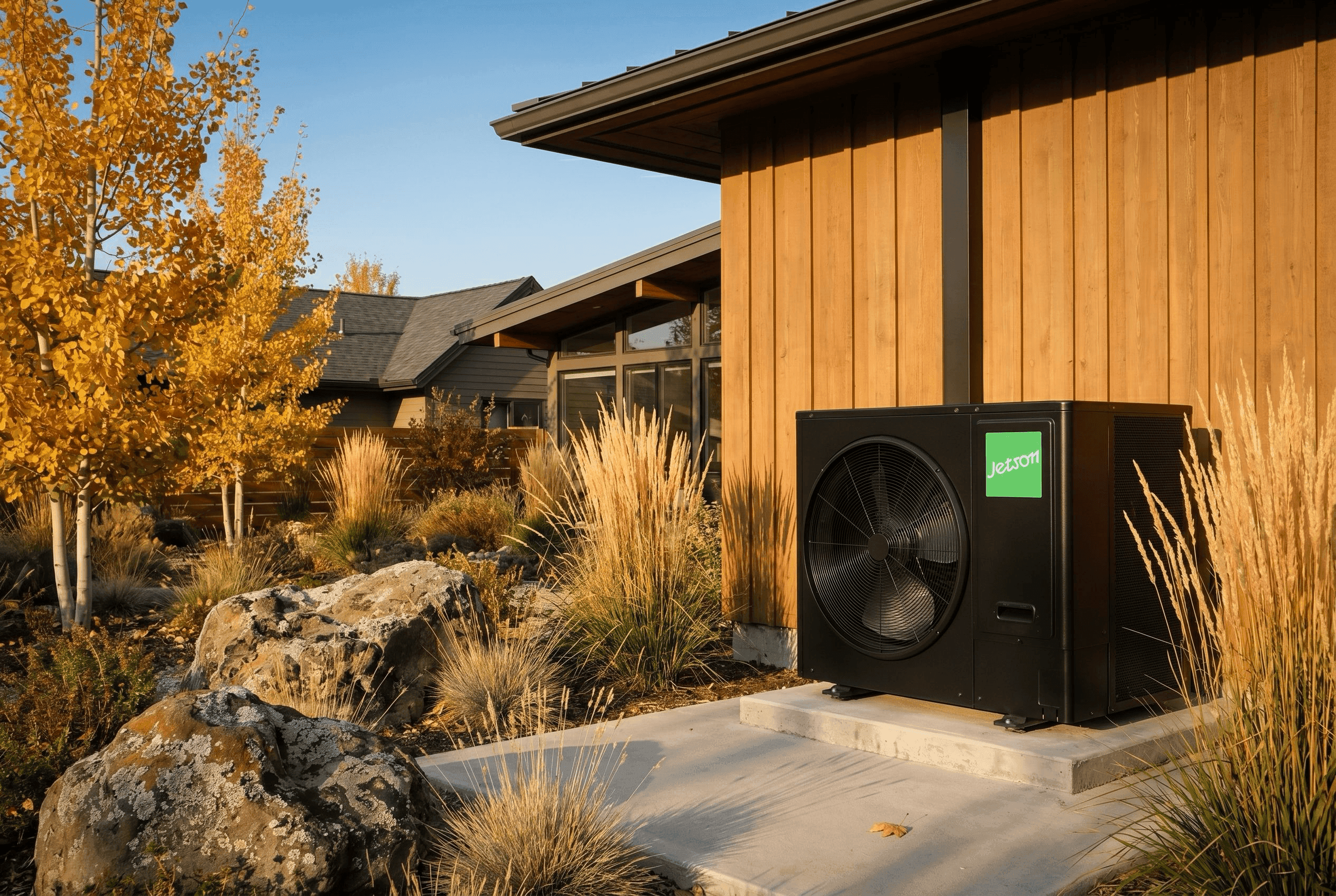
Jetson heat pump condenser installed on a concrete pad against the exterior wall of a modern Colorado home, autumn golden hour light with fall foliage

Key takeaways

Get an instant quote for your exact price, rebates included, in about two minutes. In brief:

  • Before rebates, a Jetson heat pump installation runs $14,000 to $23,000, depending on system size.
  • Financing a typical 3-ton system runs $158 to $260 a month before rebates, and your rebate can lower that to as low as $34 to $76 a month once we confirm it for your home.
  • Every Jetson installation completes in a single day, in every market.
  • Jetson Air is rated to -22°F, tied for the best cold-weather rating of any residential heat pump sold in the U.S.
  • These figures come from Jetson's own completed installation records, not a modeled national average.

What a heat pump actually costs: real 2026 prices

Here's what it actually cost across our completed installs in Colorado, Massachusetts, and New York: real prices, not modeled estimates or marketplace-quote averages, which is what most published heat pump cost figures actually are. Every price below is the system's price before rebates are applied; rebates are handled separately below, since they vary by program and change over time.

System sizePrice range (before rebates)
2-ton$14,074-$18,000
3-ton$16,503-$20,960
4-ton$16,995-$22,090
5-ton$16,995-$22,840

Figures are the range of medians for completed, single-system Jetson installations across Colorado, Massachusetts, and New York. Homes needing extra work will land above or below these numbers. See exact pricing and rebates for your area: Colorado, Massachusetts, or New York.

See your exact price and rebates
Get my price

Ben Purvis, a Jetson customer in Englewood, CO, put it this way: "Their quotes were way below those of competitors, and they actually offered an all electric solution instead of trying to sell me on a hybrid with a furnace."

Nearly 1 in 5 Massachusetts installations involve more than one system, often because Mass Save's whole-home program covers larger homes with multiple zones, compared to under 1 in 25 in Colorado. If your home has more than one heating zone, your quote will reflect that.

For context, real market data shows how much cold-climate capability costs. A standard heat pump not built for sub-freezing performance, the kind most of the country installs, runs $15,309 to $20,728 installed in the Denver market; a heat pump genuinely rated for cold, to -15°F, runs $20,752 to $28,031 there. Jetson Air is rated to -22°F, colder than that benchmark. Jetson's Colorado prices, $18,000 to $22,840, span from that standard tier into the genuine cold-climate tier, and still land below its $28,031 ceiling.

Massachusetts' program data backs this up directly. A 2026 pricing study of real Mass Save invoices, covering 875 ducted heat pump installations from late 2022 through 2024, found ducted systems averaging $6,912 per ton of installed capacity (Massachusetts Energy Efficiency Advisory Council, 2026). On a 3-ton system, the size most Jetson customers install, that works out to $20,736. Jetson's real Massachusetts price for the same size is $16,503, and our 4-ton and 5-ton systems run $4,374 and $3,499 per ton installed, both well under that average.

Rewiring America's national research ties typical cost to home size rather than one blanket number: a 1,500 to 2,500 square foot home has a median installed cost of $19,500 (range $17,000 to $23,000), while a larger, 2,500 to 5,500 square foot home runs a median of $25,000 (range $22,500 to $28,000) (Rewiring America, 2024). Jetson's 4-ton and 5-ton systems, comparable to that larger size, run $16,995 to $22,840, below the $25,000 national median.

EnergySage's marketplace-quote data by state shows a similar pattern in Massachusetts and New York: a typical heat pump there (blending ducted, ductless, hybrid, and standard non-cold-climate systems) runs $24,482 before incentives in Massachusetts and roughly $33,000 in New York, both well above Jetson's real prices in those states (EnergySage, 2026). Every comparison above is for a system rated far warmer than Jetson Air, which operates down to -22°F.

What can add to your installed cost

FactorHow often it applies (Jetson data)Typical added cost
Electrical panel upgradeAbout 1 in 10 homes in Colorado, about 1 in 28 in Massachusetts$1,500-$3,000
Multiple systems (whole-home projects)About 1 in 5 in Massachusetts, under 1 in 25 in ColoradoScales with number of systems

Most homes need neither. A typical single-system installation on existing, working ductwork is the norm, not the exception.

Rebates change what you actually pay, and they change often

Rebate programs change constantly, sometimes month to month. What follows is real data on what Jetson customers have actually received recently, not a promise of what you'll get. For the most current rebate information, get an instant quote and talk with one of our electrification advisors.

Rebates can significantly lower your price, but how much depends entirely on your household and where you live. Based on real Jetson customers who installed a 3-ton system in the last three months, rebates have run up to $18,250 in Colorado, up to $10,100 in Massachusetts, and up to $10,000 in New York. Not everyone qualifies for that much, and some households don't qualify for a rebate at all: it depends mostly on income and which programs are active when you install. For the current rebate landscape by market, see the Colorado and Massachusetts rebate guides; for New York, an instant quote will check your exact eligibility live.

Doug Birling, a Jetson customer in Centennial, CO, said the team was "knowledgeable about the product, system options, financing, and local rebates."

Rebate amounts often depend on household income, not just where you live. When you see a rebate figure quoted anywhere, check whether it assumes income qualification before comparing it to your own situation.

The federal 25C tax credit, which paid up to $2,000, expired December 31, 2025, and no longer applies to new installations (IRS Form 5695). If you installed a qualifying system before that date, you can still claim it using Jetson's Qualified Manufacturer ID. State and utility programs are what's currently active.
CHECK YOUR ELIGIBILITY
See what you qualify for

How financing changes the math

For most households, a heat pump is the third-largest purchase they'll make, after a house and a car, which is why financing terms matter as much as the sticker price. Applied to a typical 3-ton system:

TermMonthly payment (before rebates)Monthly payment (with rebates)
7-15 years$158-$260as low as $34-$76

Once your rebate is applied, that payment can drop substantially, though how much depends on your specific eligibility. Based on real Jetson customers, monthly payments have dropped as low as $34 to $76 a month with the maximum rebate applied. Not everyone qualifies for the maximum, and some households don't qualify for a rebate at all. Your specific rebate and loan terms are confirmed as part of your instant quote.

See your monthly payment

See my payment

Why heat pump prices vary so much between installers

A typical heat pump changes hands several times before it reaches a homeowner: built by one of a handful of manufacturers, rebranded by a name-brand HVAC company, sold to a distributor, sold again to the contractor, then quoted to you, with a markup added at every step. That's a big part of why two quotes for what looks like the same system can differ by thousands of dollars.

It's not just the equipment markup, either. Installer overhead, how many visits the sales and install process takes, and whether the crew handles electrical and HVAC separately or together all show up in the final price. Because Jetson manufactures its own equipment and installs it with its own crews in a single visit, those middle layers don't stack the way they do with a traditional multi-step supply chain. Jetson co-founder Stephen Lake walks through the four markups a typical heat pump passes through before it reaches a homeowner.

What a heat pump installation actually includes

A typical installation includes the outdoor unit, the indoor coil and air handler, new refrigerant lines, and connecting to your home's existing ductwork. Most cost variation between homes comes down to system size, ductwork condition, and whether your electrical panel can support the new equipment.

What size heat pump do I need?

Square footage alone doesn't determine the right system size, since insulation, window count and type, ceiling height, and layout all affect how much capacity a home actually needs. That's why Jetson sizes every system with a proprietary load analysis instead of a generic square-footage rule, since oversizing is one of the most common and costly mistakes in this industry.

Based on real Jetson installations, most homes land on a 3-ton system: about 50% of Colorado installs, 49% in Massachusetts, and 56% in New York. 4-ton is the next most common size in every market (24-26%), with 2-ton and 5-ton systems making up the rest. See the pricing table above for what each size actually costs.

Is a heat pump worth it?

The honest answer depends more on what you're heating with today than on where you live. Nationally, the average household saves about $370 a year on utility bills after switching to a heat pump. But that average hides a real split: switching from fuel oil or propane, common in older homes across Massachusetts and New York, typically saves closer to $1,000 a year, since both fuels are expensive and inefficient to begin with. Switching from natural gas, more common in Colorado, saves much less on average (Rewiring America).

We're not going to promise you a specific number, because it depends on your current fuel type, your home's efficiency, and local utility rates.

When a heat pump is the right call, and when it isn't

For most homes with existing ductwork, a heat pump replaces both your air conditioner and your heating system in one install, and after rebates, the net cost is often comparable to replacing a furnace and AC separately, while adding cooling efficiency most furnace-only setups don't have.

It isn't always the right fit. Jetson only installs central, ducted heat pumps sized to cover your home's full heating and cooling load on their own, so we don't offer a furnace or dual-fuel hybrid as a fallback: if your home lacks existing ductwork, or the ducts are too undersized to rework, we'll tell you a heat pump isn't the right call for your house rather than force a fit. In some older homes with tighter ductwork, that means sizing the heat pump down and adding an electric heat strip for the coldest days, not keeping a gas furnace around as backup.

Ducted heat pump vs. ductless (mini-split)

Ducted (what Jetson installs)Ductless / mini-split
Requires existing ductworkYesNo
Typical use caseHomes with existing ducted AC or a furnaceHomes with no ducts, additions, room-by-room zoning
National average installed cost$14,000-$23,000 (Jetson, before rebates)About $25,957 per zone (EnergySage, 2026)
Jetson installs thisYesNo

If your home doesn't have ductwork, a ductless system may be the better fit, and we'll tell you that honestly rather than sell you a ducted retrofit that doesn't make sense for your house.

COLD-CLIMATE HEAT PUMP
Meet Jetson Air

Meet Jetson Air

Rated to -22°F, tied for the best cold-weather rating of any residential heat pump sold in the U.S. Jetson prices the whole job upfront, handles your full rebate stack, and installs it in a single day, with no dealer markup layers in between.

-22°F
Rated operating temp
17.0
SEER2 rating
9.2
HSPF2 rating
COLD-CLIMATE READY

Why installation speed is actually a cost question

A traditional heat pump installation often means coordinating separate visits from an electrician and an HVAC contractor, on different days, each with their own trip costs and scheduling risk. Every day of coordination is a day something can slip, and every extra visit is a cost that shows up somewhere in the quote.

Jetson installs with one in-house crew, electrical and HVAC together, in a single day. Every completed installation in our data finished within one day, in every market: a crew of about 4 people, averaging roughly 2.7 hours per tech in Colorado, 3 hours per tech in Massachusetts, and about 4 hours per tech in New York.

Frequently asked questions

Get your exact price

Keep exploring

See all resources →

Ready to make the switch?
Let's get started!

Explore Jetson Air