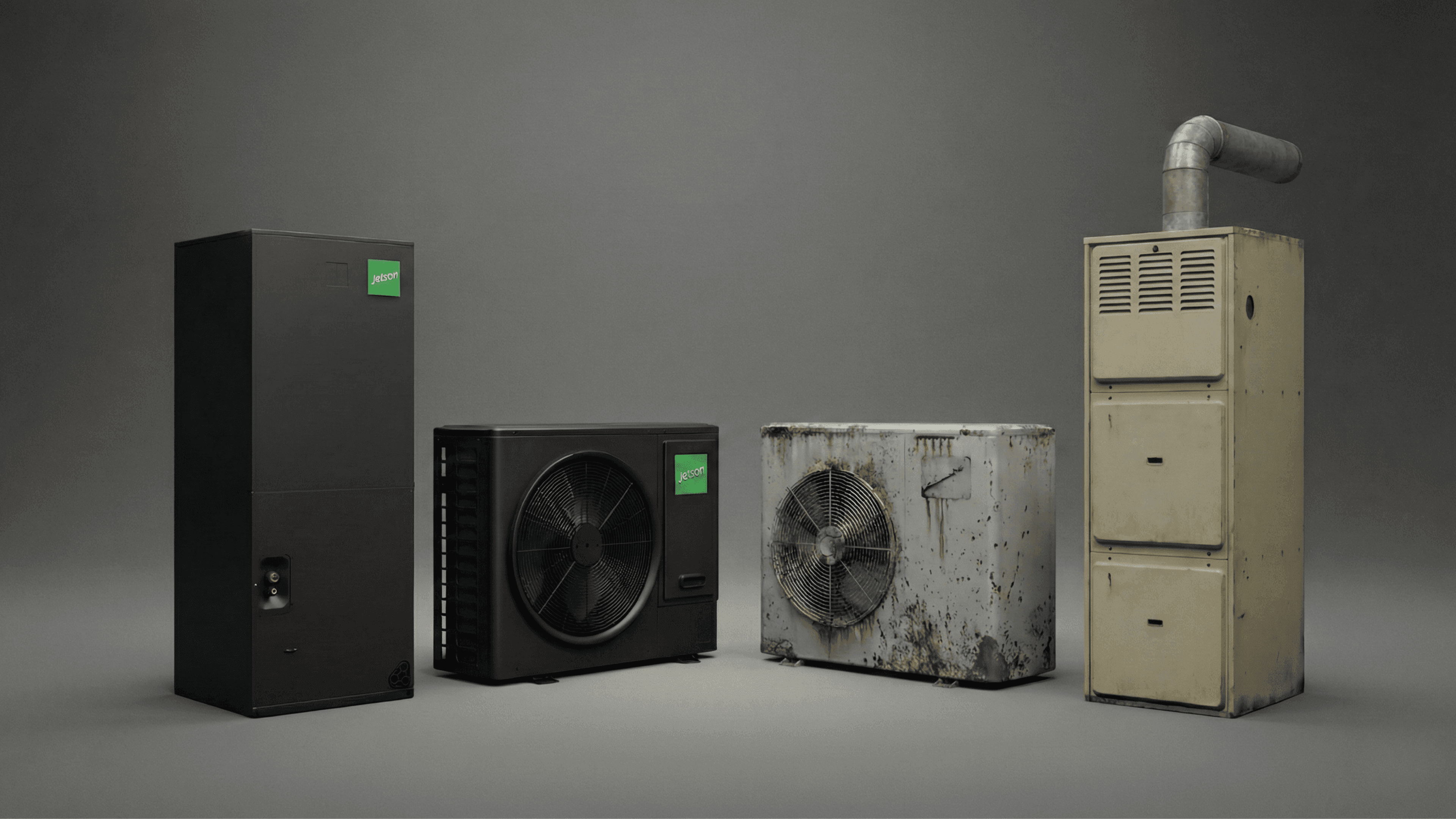
What's the difference between a heat pump and a dual-fuel system?
A dual-fuel system pairs a standard heat pump with a gas furnace. The heat pump handles heating during milder weather, but when outdoor temperatures drop below roughly 40°F, the system switches over to the gas furnace to pick up the slack. The idea is that you get the efficiency of a heat pump most of the time, with gas as a safety net for the coldest days.
The problem is that this setup assumes the heat pump can't handle real winter on its own. That was a reasonable concern ten or fifteen years ago, when most heat pumps did lose effectiveness in freezing temperatures. But modern cold-climate heat pumps are a fundamentally different technology. They're engineered to operate efficiently down to –22°F (–30°C), which means the gas furnace in a dual-fuel system isn't really a backup anymore. It's just an extra piece of equipment that adds cost, complexity, and fossil fuel dependence without solving a problem that still exists.
Do you actually need dual-fuel heating?
If you're considering dual fuel, you're probably thinking of it as a practical compromise: keep the gas furnace around just in case, and let the heat pump do the rest. That instinct makes sense, but it's based on outdated assumptions about what heat pumps can handle.
Today's cold-climate systems don't lose their footing when temperatures drop the way older models did. They use inverter-driven compressors, advanced refrigerants, and smart controls that continuously adjust output to match conditions. These systems maintain strong efficiency through subzero temperatures, and they've been proven in climates far harsher than most of North America. Over 70% of Norwegian households rely on heat pumps as their primary heating source, and Norway isn't exactly known for mild winters.
When you go with a single cold-climate heat pump, you get one system that handles both heating and cooling year-round, without burning fossil fuels. There's no switchover point where the system hands off to a furnace. There's no gas line to maintain, no combustion happening inside your home, and no carbon monoxide risk from a burner in your basement. You also don't have to coordinate maintenance, repairs, or eventual replacement for two separate pieces of equipment.
Dual-fuel systems made sense when heat pump technology couldn't keep up in cold weather. That's no longer the case, and holding onto the gas furnace adds cost and complexity without adding comfort.
Is a dual-fuel system better for freezing temperatures?
No. A dual-fuel system does switch to a gas furnace when temperatures drop, but that doesn't mean it's performing better. It means the standard heat pump in the system wasn't designed for cold weather, so it needs help. A cold-climate heat pump doesn't have that limitation. It's built from the ground up to deliver reliable heat through subzero conditions without falling back on combustion.
The idea that gas is inherently more reliable in extreme cold is one of the more persistent misconceptions in home heating. Gas furnaces produce a fixed amount of heat regardless of outdoor temperature, but they do it by burning fuel at roughly 95% efficiency at best. A cold-climate heat pump operating in the same conditions still delivers two to three times more heat per unit of energy consumed, because it's moving heat rather than generating it. Even at its least efficient operating point in very cold weather, a properly sized heat pump outperforms a gas furnace on energy usage.
Part of the reason dual-fuel systems are still recommended so often is that many HVAC contractors are more experienced with gas equipment. Gas furnaces and dual-fuel setups have been the industry standard for decades, and selling and maintaining two systems generates more revenue than installing one heat pump. That's not a conspiracy, it's just how the economics of the trade have worked. But it means homeowners are sometimes steered toward more complex, more expensive setups when a simpler all-electric option would serve them better.
What kind of heat pump is in a dual-fuel system?
This is worth understanding because the equipment quality difference is significant. In a dedicated cold-climate heat pump installation, the indoor unit is a heat pump air handler, a purpose-built component with a fully variable-speed blower designed to work in concert with the outdoor unit. The system is engineered as an integrated package. The indoor and outdoor units communicate constantly, adjusting airflow and output together to maximize efficiency and keep noise levels low.
A dual-fuel system takes a different approach. The indoor unit is a conventional gas furnace, usually a single-speed or two-speed model, with a heat pump coil mounted on top. It's really just a furnace with a coil added on, similar to how a traditional air conditioner is set up, rather than a fully integrated heat pump system. The furnace blower wasn't designed to optimize heat pump performance, and without variable-speed control the system can't modulate its output the way a dedicated heat pump air handler can. That means less efficiency, more noise, and less precise temperature control even during milder weather when the heat pump side is doing the work.
So the tradeoff with dual fuel isn't just about keeping a gas furnace around as backup. You're also getting a lower-performing heat pump experience during the majority of the year when the heat pump is your primary heating and cooling source.
Which is cheaper: a heat pump or dual fuel?
A heat pump is less expensive to operate than a dual-fuel system for a couple of straightforward reasons. First, modern cold-climate heat pumps deliver two to five times more heat per unit of energy than a gas furnace, even in freezing temperatures. Gas furnaces max out at about 95% efficiency, which means you're always losing some energy in the combustion process. A heat pump at even its worst winter performance typically beats that.
Second, dual-fuel systems cost more at every stage. You're buying both a heat pump and a gas furnace upfront, plus the controls needed to manage the switchover between them. If you don't already have a gas line, that's another expense. You're maintaining two systems instead of one, and eventually replacing two systems instead of one. Over a 15 to 20 year equipment lifespan, those added costs are significant.
There's also the gas connection itself. Even if your furnace only kicks in a handful of days per year, you're still paying a monthly gas utility bill to keep that connection active. Those fixed charges add up over time regardless of how little gas you actually burn. And while it's true that on the very coldest individual days a gas furnace might cost slightly less per hour to run than a heat pump, the percentage of the heating season where that's the case is so small that it doesn't come close to offsetting the added cost of maintaining a second system, paying for the gas connection, and covering the higher upfront and maintenance expenses that come with dual fuel.
When you factor in the rebates and incentives available for all-electric heat pump installations, the financial case for skipping dual fuel gets even stronger. Most federal, state, and utility incentive programs are designed to encourage homeowners to move away from fossil fuels entirely, and a dual-fuel system that still burns gas typically qualifies for fewer or smaller rebates than an all-electric setup.
How do I know if I need dual fuel or a cold-climate heat pump?
If you're asking this question, you almost certainly just need a cold-climate heat pump. The scenarios where dual fuel genuinely makes sense have narrowed to the point where, for most homeowners, the answer is straightforward.
A properly sized cold-climate heat pump provides year-round heating and cooling through the full range of winter temperatures you'll experience in any of the markets where Jetson operates. It's simpler, less expensive to maintain, eligible for better incentives, and doesn't require a gas connection. If your home currently has a gas furnace and you're thinking about what to replace it with, a cold-climate heat pump is the more practical and more cost-effective path forward.
If you're weighing the two, you can see what an all-electric system would cost for your home in a couple of minutes, no contractor visit to schedule.