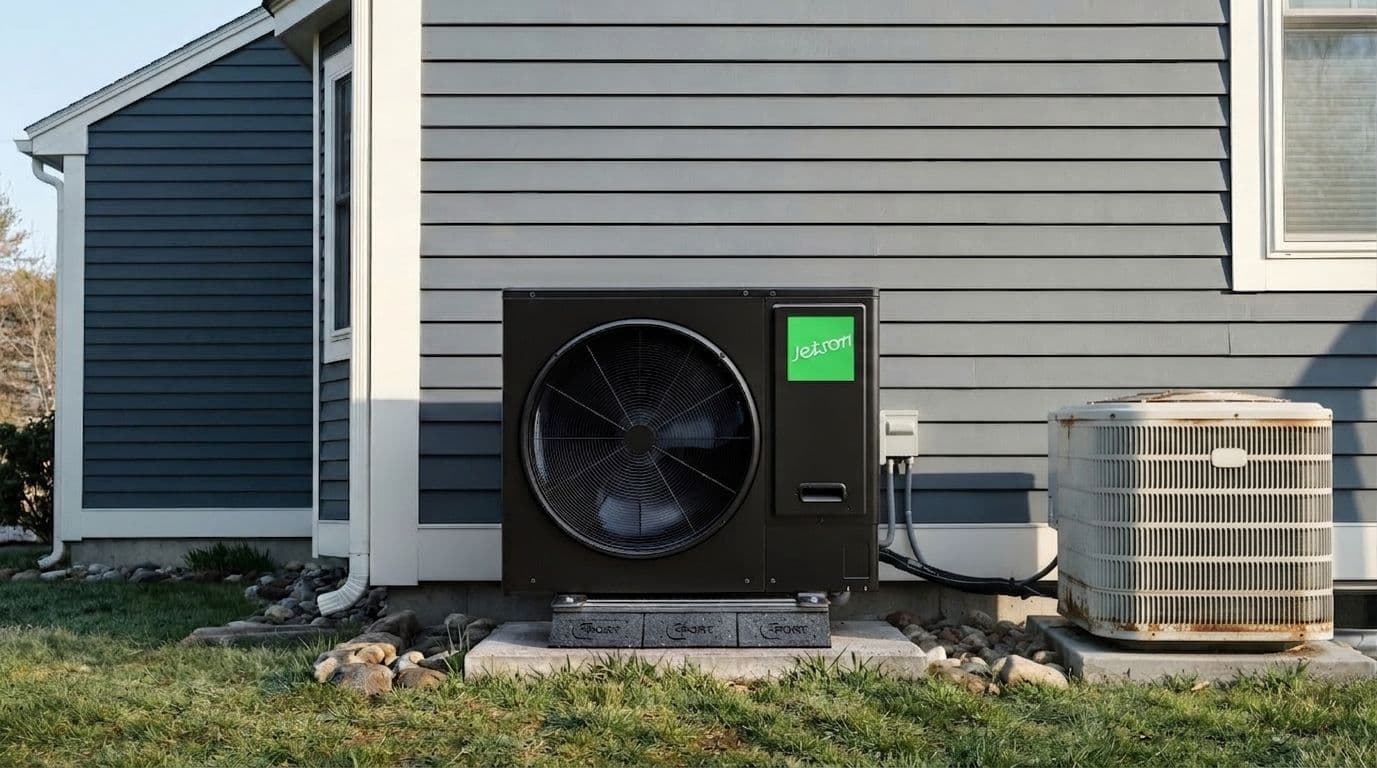
How Heat Pumps Cool Your Home
A heat pump cools your home the same way an air conditioner does. Refrigerant absorbs heat from your indoor air, carries it outside, and releases it there. The indoor coil (the evaporator) gets cold, a fan blows your home's air across it, and that cooled air circulates through the house.
The mechanical process is identical in both systems. You have a compressor, an outdoor coil, an indoor coil, and refrigerant flowing between them. The only structural difference is that a heat pump includes a reversing valve, which lets it flip the direction of refrigerant flow. In summer it moves heat out of your house. In winter it moves heat in. An air conditioner can only do the first part, so you need a separate furnace or other heating system to handle winter.
In cooling mode, a heat pump and an air conditioner are doing the same fundamental job. The efficiency difference doesn't come from the cooling process itself. It comes from the type of compressor and controls each system uses, and that's where the comparison gets interesting.
SEER2, EER2, and Heat Pump COP Explained
When you're comparing an air conditioner to a heat pump for efficiency, three ratings matter: SEER2, EER2, and COP. They measure slightly different things, and understanding all three gives you a much clearer picture than relying on a single number.
SEER2 (Seasonal Energy Efficiency Ratio 2) is the headline number you'll see on most equipment specs. It measures cooling efficiency across an entire season of varying temperatures and loads. Higher is better. The current federal minimum is 13.4 SEER2 for split systems. The most common single-stage ACs from major brands like Carrier, Trane, and Lennox typically land in the 14 to 15 SEER2 range. The Jetson Air heat pump comes in at 17 SEER2, which is a meaningful step up from those standard units while keeping the system ducted and compatible with your existing ductwork.
EER2 (Energy Efficiency Ratio 2) measures efficiency at a single high-load condition, essentially peak cooling on a hot day. This is arguably more useful than SEER2 for homeowners in consistently hot climates because it tells you how the system performs when it's working hardest. A typical single-stage AC posts an EER2 around 10 to 11. The Jetson Air sits at 11.7, so even at peak load on the hottest days, it's outperforming the standard equipment.
COP (Coefficient of Performance) is the most straightforward of the three. It's the ratio of cooling output to electrical input. A heat pump COP of 4.0 in cooling mode means you get four units of cooling for every one unit of electricity you pay for. Modern inverter heat pumps routinely achieve a cooling COP between 3.5 and 5.0, depending on conditions. A standard single-stage AC typically lands between 2.8 and 3.5. That difference might not seem dramatic on paper, but it compounds across every hour of operation throughout the summer. Over a full cooling season, the gap between a COP of 3.0 and a COP of 4.5 adds up to hundreds of dollars.
Part-Load Performance: Where Inverter Heat Pumps Pull Ahead
This is the most important section in this article, and the one that most manufacturer comparison pages skip over entirely. Efficiency ratings tell part of the story. How a system handles part-load conditions tells the rest.
Your cooling system doesn't run at full capacity most of the time. On a 95°F day, it might need 100% output. But on an 82°F afternoon, or at 7 PM when the sun drops behind the trees, it might only need 30 to 50% of its rated capacity. This is called part-load operation, and your system spends roughly 80% or more of its running hours here in most climates.
A traditional single-stage air conditioner has one speed: full blast. When your thermostat calls for cooling, the compressor kicks on at 100%. When the temperature hits the setpoint, it shuts off completely. Then it waits until the temperature climbs again and fires back on at full power. This cycling is inherently wasteful. The compressor draws the most energy during startup, and the system can never match its output to what your home actually needs at any given moment. You end up with temperature swings of two to three degrees as the system overshoots, shuts off, and waits for the house to warm up again before re-engaging.
An inverter heat pump works differently. Its compressor adjusts speed continuously, ramping up and down to match the exact cooling load. On a mild afternoon it might cruise at 25% capacity, using a fraction of the electricity while holding a perfectly consistent temperature. When a heat wave hits, it ramps to full output and then backs down as conditions ease. The result is steady, even cooling with no temperature swings and no wasted startup energy.
The efficiency gains at part load are substantial. When an inverter heat pump runs at 30 to 50% capacity, its effective COP can climb well above its rated full-load number, sometimes reaching 6.0 or higher. A single-stage AC never gets this benefit because it only operates at 100% when it's on. Over a full cooling season, where most operating hours fall below full load, an inverter heat pump can use 30 to 40% less electricity than a comparable single-stage AC.
Humidity and Latent Heat
One of the most common questions homeowners ask is whether heat pumps remove humidity as effectively as traditional air conditioners. Inverter heat pumps typically do it better, and the reason connects directly to how their compressors operate.
When a cooling system runs, it does two things at once. It lowers the air temperature (sensible cooling) and it pulls moisture out of the air (latent cooling) as water vapor condenses on the cold evaporator coil. The longer a system runs continuously, the more moisture it removes. Short cycling, where the system blasts cold air and then shuts off before it's had time to dehumidify properly, is one of the most common comfort complaints in homes with older single-stage ACs. The thermostat reads the right temperature, but the house still feels clammy.
An inverter heat pump running at lower capacity keeps air moving across the coil for much longer stretches. The coil stays cold and active, continuously extracting moisture rather than cycling on and off. Many homeowners who switch from a standard AC to an inverter heat pump notice the humidity improvement before they notice the temperature difference. Your home feels more comfortable at the same thermostat setting, which often means you can set the temperature a degree or two higher and still feel great, saving a bit more energy in the process.
Ducted vs. Ductless: Understanding the Efficiency Ratings
If you've been researching heat pumps, you've probably noticed that ductless mini splits post higher SEER2 numbers than ducted systems. A ductless unit might advertise 24 or even 28 SEER2, while a ducted heat pump like the Jetson Air comes in at 17. That looks like a big gap on paper, but the numbers are measuring different things.
Ductless systems are tested for the efficiency of a single indoor unit cooling the immediate room it's installed in. Ducted systems are tested for whole-home efficiency, which includes the energy required to move air through your entire duct network and condition every room in the house simultaneously. The ductless number isn't wrong, but it's not directly comparable to a ducted rating.
In practice, for homes that already have ductwork (which is most homes), a ducted heat pump is typically just as efficient at keeping your whole house comfortable. You get even temperatures in every room through your existing vents, with a single outdoor unit and a single indoor air handler. There's no need to install separate wall-mounted units in each room, run new refrigerant lines through your walls, or figure out how to heat and cool hallways and bathrooms that don't have their own ductless head.
If your home has ductwork in reasonable condition, a ducted heat pump is the straightforward choice. It uses the infrastructure you already have, heats and cools every room from one system, and delivers real-world efficiency that matches or exceeds what most homeowners would actually experience with a multi-zone ductless setup.
Real-World Operating Cost Math
Here's how the heat pump vs. air conditioner cost comparison plays out with real numbers. We'll use a typical 3-ton ducted system with about 1,200 equivalent full-load cooling hours per season (a reasonable US average) and the current national residential electricity rate of $0.17 per kWh.
A 3-ton system produces 36,000 BTU/hr at full capacity. Here's how annual cooling costs break down by system type:
| System Type | SEER2 | Est. Annual Cooling Cost |
|---|---|---|
| Standard single-stage AC | 14 | ~$532 |
| Two-stage AC | 16 | ~$465 |
| Jetson Air heat pump | 17 | ~$438 |
The math is straightforward: (BTU/hr x EFLH) / (SEER2 x 1,000) x electricity rate. A homeowner replacing a 14 SEER2 air conditioner with the Jetson Air at 17 SEER2 saves roughly $80 to $95 per year on cooling alone, with a broader range of $60 to $110 depending on your climate and usage patterns. Over the 15 to 20 year lifespan of the equipment, that adds up to $1,400 to $1,900 in cooling savings before you even factor in the heating side.
And cooling is actually the smaller part of the equation for most homes. The bigger financial shift comes from what a heat pump does that an air conditioner can't: it also heats your home.
One System Instead of Two
This is where the comparison shifts from an efficiency discussion to a fundamentally different financial picture. An air conditioner only cools. You still need a furnace, boiler, or some other heating system to get through winter. A heat pump handles both heating and cooling in a single unit.
That means one system to install instead of two, one system to maintain, and one system to eventually replace. If your furnace is 15 years old and your AC is on its way out, you're looking at replacing both in the near future anyway. A heat pump lets you handle that with a single installation, which typically costs less than buying a new AC and a new furnace separately.
The ongoing savings add up quickly. You're eliminating fuel costs entirely if you're currently heating with gas, propane, or oil. For homes on propane or oil, the annual heating savings alone can reach $1,000 to $2,500 depending on your climate and current fuel prices. Even homes with natural gas often see meaningful savings because a heat pump moves heat rather than creating it from combustion, using significantly less energy to keep your home at the same temperature.
There's also a maintenance advantage that's easy to overlook. A gas furnace has a heat exchanger, burners, a gas valve, a flue, and a draft inducer motor, all of which require inspection, cleaning, and eventual replacement. A heat pump has none of those parts. You're maintaining one piece of equipment instead of two, with no combustion components to worry about. Over a 15 to 20 year lifespan, that's a real reduction in both cost and hassle.
Rebates and Incentives
Heat pumps are one of the most heavily incentivized home upgrades available right now. Federal tax credits, state rebate programs, and local utility incentives can all apply, and in many cases you can stack multiple programs together. The specifics depend on where you live, your household income, and the efficiency of the system you install, but it's not unusual for homeowners to offset 30 to 50% of total installation costs through available programs.
The landscape changes frequently as new state programs roll out and utility companies update their offerings, so the best approach is to check what's currently available for your specific situation. When you get an instant quote from Jetson, we automatically calculate which federal, state, and utility rebate programs you're eligible for based on your home's location and the system we're recommending. You'll see the full breakdown of available incentives right in your quote.
FAQ
Is a heat pump more efficient than an air conditioner for cooling?
Yes. A modern inverter heat pump is more efficient than a conventional air conditioner in cooling mode. The advantage comes from variable-speed compressor technology that matches output to actual demand rather than cycling on and off at full capacity. In typical conditions, this translates to 20 to 40% less electricity used for cooling.
Do heat pumps cool as well as air conditioners?
Heat pumps cool just as effectively as air conditioners because they use the exact same refrigeration process. Many homeowners actually report better comfort after switching to an inverter heat pump, thanks to more consistent temperatures and improved humidity control from the variable-speed operation.
Do heat pumps remove humidity?
Yes, and inverter heat pumps typically handle humidity better than standard air conditioners. The compressor runs at lower speeds for longer stretches, which keeps air moving over the cold evaporator coil continuously and extracts more moisture. A single-stage AC that short-cycles can cool the air without adequately dehumidifying, leaving your home feeling clammy even at the right thermostat setting.
How much can I save switching from an AC to a heat pump?
For cooling alone, switching from a 14 SEER2 AC to a 17 SEER2 heat pump like the Jetson Air saves roughly $80 to $95 per year depending on your climate and usage, which adds up to $1,400 to $1,900 over the life of the equipment. The larger savings come from heating: replacing gas, propane, or oil heat with a heat pump can save $1,000 to $2,500 annually. You're also replacing two systems (AC plus furnace) with one, which reduces both upfront equipment costs and long-term maintenance. Factor in available rebates, and the upfront cost difference often pays back within 3 to 5 years.
Ready to See What a Heat Pump Can Do for Your Home?
Jetson installs high-efficiency heat pump systems tailored to your home's specific needs. Every project starts with a thorough assessment of your space, your current equipment, and every rebate you're eligible for. If you're thinking about replacing an aging air conditioner, a heat pump gives you better cooling, built-in heating, and access to the best available incentives. Get a free quote to find out what makes sense for your home.