Still have questions?

Talk directly with a Jetson Expert to learn more.

Best Heat Pumps in 2026, Compared by Manufacturer

Real specs, real reviews, and the honest tradeoffs, including our own.

ByJetson Team·Jetson Home·24 min read

We evaluated Mitsubishi, Daikin, Carrier, Trane, Bosch, newer names like Quilt, and our own Jetson Air on real AHRI-certified numbers, not marketing copy, and said honestly where each one wins.

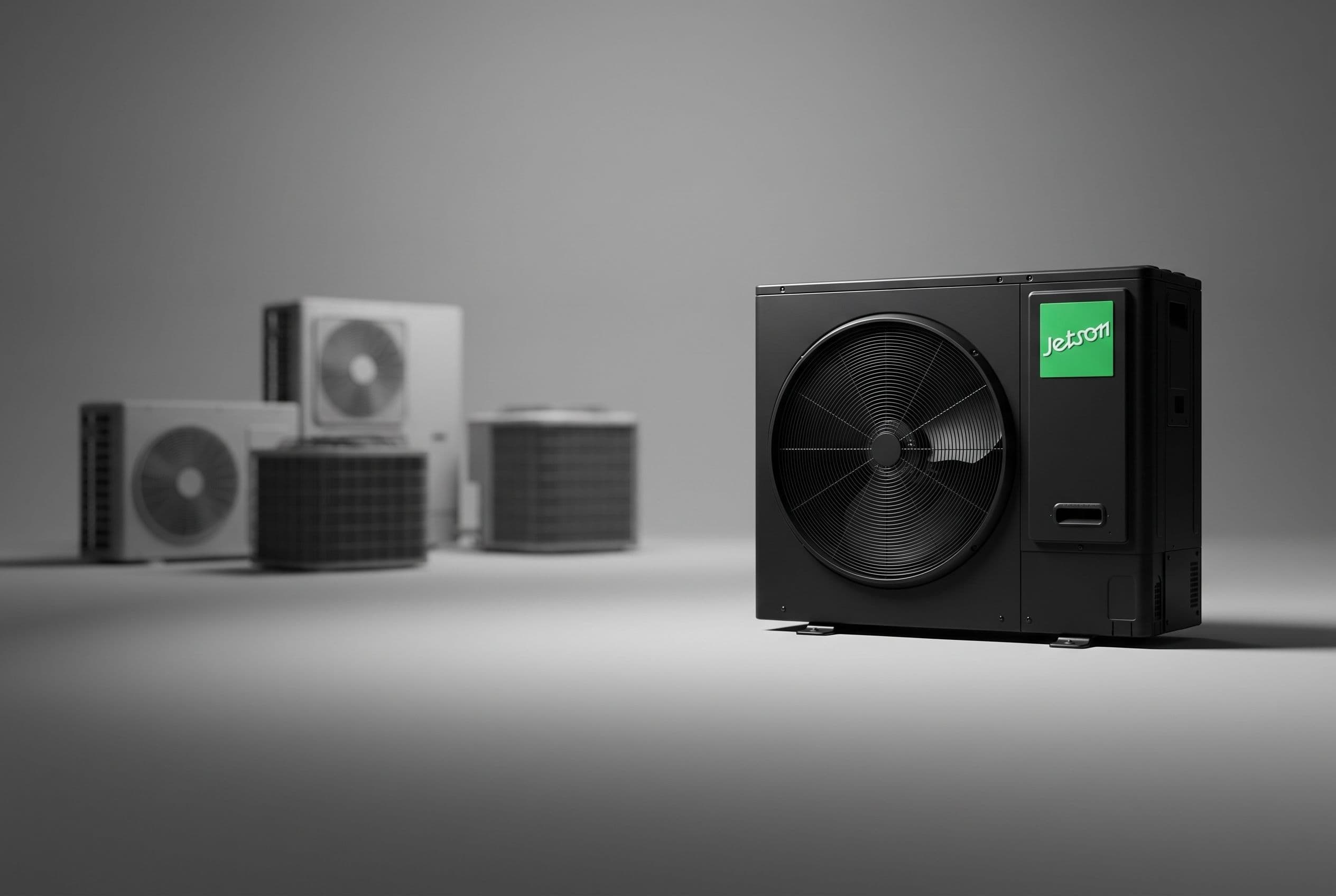
Studio photograph of the Jetson Air heat pump condenser with other heat pump units blurred in the background, rule of thirds with generous breathing room

The best heat pump for most homes right now is Jetson Air, an all-electric, cold-climate system rated to -22°F. For homeowners who specifically want a globally recognized brand name, or need a configuration Jetson doesn't offer, Mitsubishi's ductless lineup and Daikin's dealer network are both real, honest alternatives, and we'll say exactly where each one makes more sense than we do.

Every pick below is judged the same way: real efficiency numbers pulled from AHRI certificates (AHRI is the independent industry group that verifies manufacturer efficiency claims), not manufacturer marketing copy, real reviews from actual installers and owners, and an honest account of where each system falls short. No one paid for placement here, and where a competitor is the better fit for your home, we say so directly rather than bury it in a footnote.

What to look for

Four things matter more than any brand name:

  • Warranty coverage. Does it actually cover labor, not just parts? A covered part with no labor coverage still means an out-of-pocket repair bill, and that's where a lot of the real cost difference between brands shows up after the sale.
  • Ducted or ductless. A ducted system reuses the same vents and ductwork a furnace or central AC already uses; a ductless system (also called a mini-split) uses individual wall-mounted units room by room, no ductwork at all. This alone rules half the market in or out for your home before anything else matters.
  • Real cold-climate certification. Is the specific unit ENERGY STAR Cold Climate certified, and what outdoor temperature is it actually rated to keep heating down to? Older heat pumps lost real heating power once it got cold outside, which is where the idea that you need a separate furnace as backup comes from. A properly certified cold-climate system doesn't have that problem: one unit handles both heating and cooling on its own, no separate heat source required.
  • SEER2 and HSPF2 for the exact model quoted. SEER2 measures cooling efficiency and HSPF2 measures heating efficiency across a full winter; a brand's "up to" family rating and the number on your actual unit's AHRI certificate aren't always the same thing. A higher number here doesn't automatically mean a better fit for your climate, either: a unit built for mild-weather efficiency can post a higher SEER2 or HSPF2 than a genuine cold-climate unit, precisely because it isn't engineered to keep performing once temperatures drop. Read this alongside the cold-climate rating above rather than chasing the biggest number on its own.

We'll flag all four for every pick below. With those in mind, here's how the seven picks shake out at a glance:

Top 3 picks

  • Best overall: Jetson Air. A cold-climate ducted system rated to -22°F, sold and installed directly with no dealer markup, one upfront price, and a warranty and monitoring setup most legacy brands can't match.
  • Best for ductless: Mitsubishi. The most mature, best-reviewed ductless lineup on the market, though its ducted equipment is the weaker part of the catalog.
  • Best if you want a national dealer network: Daikin. Widely available through independent dealers, with real efficiency numbers worth checking against the specific unit you're quoted rather than the family rating on the box.

Full details on all seven picks, including where each one beats Jetson Air, are below.

Skip to the answer

See your own price before you read another spec sheet

Get my price

Quick comparison

Each column is one real model, not a brand average. Daikin's numbers are from an actual customer quote, not the "up to" rating on the box, more on that below. Carrier, Trane, and Bosch's numbers are in their own sections; verify any figure here against AHRI before relying on it.

Jetson Air HP-48
Mitsubishi SVZ
Daikin FIT
Quilt 2-zone
SEER2
17
17.10
16.2
25
HSPF2
9.4
9.2
8.1
12 / 9.5
Cold-climate certified
Yes
Confirm per model
No
Yes
Type
Ducted, whole-home
Ducted
Ducted
Ductless, multi-zone
Labor warranty
Parts + labor, 10yr, via Care Plus
Parts only, dealer-dependent labor

1. Jetson Air: best overall, and the one we make

Start with the equipment itself. The current 4-ton system (HP-48) is rated to keep heating efficiently down to -22°F, and it's certified at SEER2 17, HSPF2 9.4, and EER2 10.8, real numbers you can check yourself against the AHRI Directory, not our word for it. It carries both ENERGY STAR Most Efficient and ENERGY STAR Cold Climate certifications, not just one or the other.

In short
Meet Jetson Air

Meet Jetson Air

One upfront fixed price, sized from real data rather than a home visit, installed in a day by our own crews, with rebates filed for you. No good/better/best upsell menu, and no distributor or dealer markup stacked into the price.

TIME's Best Invention 2025

What makes the purchase itself different is the business behind it. A traditional heat pump passes from manufacturer to distributor to dealer to installer, and each one adds its own markup before you ever see a price. Jetson skips that chain: it designs the system, the software, and the Smart System technology, sizes and specifies each home directly, and sells and installs the result itself, partnering with a manufacturer for production but cutting out everyone in between.

That shows up most clearly in how a system gets sized. Jetson sizes each home remotely from real data (climate, altitude, square footage, and photos of your home), using its own methodology validated against National Renewable Energy Lab research, rather than a generic rule of thumb or a salesperson's in-home visit. That matters because an oversized system runs less efficiently and cycles on and off more, a genuinely common problem in this industry since a replacement system often just gets matched to the size of the one coming out, even when that original unit was oversized to begin with.

It also means one upfront, fixed price, with no good/better/best upsell menu designed to anchor you toward a pricier tier, and no wondering whether a better negotiator down the street got a lower number for the same job. Jetson's own crews (trained at a dedicated facility in Denver, not subcontracted) handle the full install, usually in a single day, and Jetson handles the rebate paperwork rather than leaving it to you.

Warranty coverage follows the same pattern: it's parts and labor together, not just parts, a genuinely different structure from the parts-only warranties most of the rest of this list carries. More on why that split matters, and what it actually costs you when it's missing, in the warranty section below.

That same setup keeps paying off after the sale closes, because Jetson Air is a connected system that keeps improving over time, the way a phone or a Tesla gets better through software rather than staying frozen at the spec sheet from the day it was bought. In July 2026, Jetson rolled out Air Quality Monitoring to every existing customer automatically, no new hardware, nothing to set up, because the sensors were already built into the system. As Jetson co-founder and CEO Stephen Lake put it: "thousands of existing homes will receive a new feature they didn't have when the equipment was installed, something no other central heat pump system can do." Jetson Air was named one of TIME's Best Inventions of 2025 for this same reason.

  • What we're good at: all-electric, whole-home ducted conversions, in-house crews for the full job including electrical, continuous air quality monitoring (PM2.5, CO2, smoke, VOCs), 24/7 remote monitoring, and rebates calculated and filed for you.
  • Good to know: we only install central ducted systems, so if your home has no ductwork, one of the ductless picks below is the better fit. We're also only available in a handful of North American markets right now, not nationwide.

Best for: homeowners who want a modern, software-enabled, whole-home ducted system, where one company handles and simplifies everything from sizing to install to rebates, no juggling separate vendors or sitting through a sales visit, and a high-performing, top-of-the-line unit without the several layers of markup a traditional purchase adds.

No dealer, no distributor, one price

See my price without the layers of markup

Get my price

2. Mitsubishi: best for ductless, honest tradeoffs on ducted

Mitsubishi actually sells two distinct product lines worth separating rather than judging as one brand, since the real numbers and reputations diverge sharply between them.

On the ductless side, the single-zone Hyper Heat H2i MSZ-FS12NA is listed at SEER2 26.3, real numbers for that specific unit, not a brand-wide claim. A real installer's independent review of the category (not manufacturer-sponsored) calls Mitsubishi ductless "the highest quality brand on the market," "best-in-class, reliable." If your home has no ductwork and you want individual room control with wall-mounted units, that reputation is earned.

The ducted side is a different story, and it's the actual comparison point against a whole-home system like ours. The same review certifies Mitsubishi's ducted SVZ line at SEER2 17.10 and HSPF2 9.2, almost identical to our own certified numbers, and Hyper-Heat outdoor units in this configuration are rated down to -13°F, short of the -22°F Jetson Air is certified for. But the review still concludes Mitsubishi "didn't focus on upgrading their ducted equipment" through recent refrigerant-generation changes, and that buyers "may benefit from trying another brand" for ducted value specifically. Warranty coverage adds another wrinkle worth knowing: Mitsubishi's strongest parts coverage (up to 12 years) only applies if a Mitsubishi-certified Diamond Contractor does the install, so the number you actually get depends on which installer you hire, not just which unit you buy. That's not one reviewer's opinion in isolation. A 95-comment HVAC installer thread has multiple contractors telling a homeowner directly that they'd stopped carrying Mitsubishi because ducted units were proving unreliable, with some equipment reportedly being phased out. One commenter put the broader shift plainly: other manufacturers "have caught up and even surpassed them in cold weather heat pump technology now," often at a much lower price. Another made a point worth carrying into every comparison on this page: "brands typically matter much less than models... and the skill/quality of the installing contractor," a real account in the same thread describes a Mitsubishi-certified installer botching a job entirely.

  • What they're good at: the Hyper Heat ductless lineup specifically (e.g. MSZ-FS12NA), room-by-room zoning, broad brand recognition.
  • Good to know: the ducted SVZ lineup hasn't kept pace with Mitsubishi's own ductless reputation, per real installer accounts, confirm the exact model and its current specs before assuming the brand name alone guarantees ducted performance.

Best for: homes without ductwork that want individual room zoning on the Hyper Heat ductless lineup, or homeowners who specifically want Mitsubishi's brand recognition. See our full Jetson Air vs. Mitsubishi Hyper-Heat comparison for the complete spec table and sourcing.

3. Quilt: a newer, software-forward challenger

Quilt is a newer company building ductless, multi-zone systems with the same direct-to-consumer, software-forward approach Jetson takes: trained-crew installs and an app for ongoing control. It's worth naming separately since it's the closest thing to a direct peer on this list. As a newer entrant, independent long-term reviews are still limited, so treat its numbers as company-published until more third-party data exists.

Quilt's 2-zone system (outdoor unit QO1-M2Z18-NC-NA) is AHRI-certified at SEER2 25 and HSPF2 12 in the warmer-climate Region IV rating, or 9.5 in the colder Region V rating, and it's ENERGY STAR Cold Climate certified. Quilt's own published cold-weather capacity table shows the system still delivering 18,000 BTU/h of heating at 5°F, tapering to 16,000 BTU/h at -13°F, real manufacturer-published cold-climate figures rather than a marketing "up to" range. As a newer company, its warranty follows the standard structure: parts are covered by Quilt, and labor coverage is set by whichever dealer handles your install, so ask what that specific dealer offers before assuming it matches the parts term.

  • What they're good at: ductless multi-zone with strong published cold-weather capacity retention, a modern app-based control experience.
  • Good to know: it's a ductless system, solving a different problem than a whole-home ducted furnace replacement, so it's not a direct substitute if what you need is a whole-home conversion.

Best for: homes without ductwork looking for a modern, software-forward ductless system from a newer company building toward the same kind of experience Jetson does, zone by zone rather than whole-home.

4. Daikin: real numbers matter more than the SEER2 on the label

Daikin makes a genuine point of confusion worth walking through directly, because it shows up on real customer quotes, not just in the abstract. A real installed-system estimate we reviewed advertised a Daikin FIT unit at "up to 21 SEER2." The actual 4-ton system being quoted, the one that would go in the home, was certified at 16.2 SEER2, 8.1 HSPF2, and wasn't ENERGY STAR Cold Climate certified at all. The "up to 21" figure describes the smallest unit in Daikin's FIT lineup (a 2-ton), not the one being sold, and it's a broader pattern than one estimate, most manufacturers publish a family-wide "up to" rating built around their best-performing size.

Separately, Daikin's Fit DX6VS line is quoted in real customer accounts at "17 SEER," close to our own headline number, though that figure wasn't specified as SEER2 in the source, and the two standards aren't interchangeable. One real buyer also reported no Daikin service provider within four hours of their home, a genuine tradeoff in areas with a thinner dealer network. The FIT lineup is also ductless (individual wall-mounted units rather than shared vents and ductwork), so it's solving a different problem than a whole-home ducted system like Jetson Air or Daikin's own ducted lines. Like most brands here, Daikin's manufacturer warranty covers parts only, with labor coverage set separately by whichever dealer installs it. See our full Jetson Air vs. Daikin comparison for the real example this section is based on.

  • What they're good at: quiet inverter operation, a broad dealer network in many regions.
  • Good to know: confirm the exact model's AHRI-certified SEER2 and HSPF2 numbers, not the family "up to" rating on the box or the estimate, and check real local service availability before assuming dealer coverage.

Best for: homeowners in a region with strong local Daikin service support who've confirmed the specific quoted unit's real certified numbers.

5. Carrier: a real, capable system, worth knowing which tier you're quoted

Carrier sells three real tiers, not one product: entry-level Comfort™, mid-tier Performance™, and flagship Infinity®. Infinity itself splits into two current flagships depending on the job: the Infinity 23 Heat Pump (model 27VNA3) is the efficiency flagship, AHRI-certified at up to 23 SEER2, 10.5 HSPF2, and 13.5 EER2, but rated on Carrier's own product page only down to -13°F, while the Infinity 21 Ultimate Cold Climate Heat Pump (27VNA1) is the cold-climate flagship, lower on paper at 21.2 SEER2 and 12.5 HSPF2, but built to keep producing heat down to -23°F. Both use a genuinely capable variable-speed compressor, running longer at a lower output instead of cycling on and off at one fixed level, though that's standard across nearly every brand in this comparison now: Jetson Air, Mitsubishi, Daikin, Trane, and Bosch all use them too, so it's not really a Carrier-specific edge. Carrier's real differentiator here is scale, one of the largest dealer networks in the country, and the price that comes with it. Carrier sells both ducted and ductless configurations, so confirm which one you're actually being quoted. Warranty terms also carry a real catch: Carrier's parts coverage runs 10 years if you register within 90 days of install, but drops to just 5 years if you miss that window, and labor is a separate arrangement with your dealer.

A homeowner posted three actual contractor bids for the same 3-ton job on r/heatpumps: one region, one house, a real, useful reference point rather than a national average, since installed pricing varies enormously by market and isn't something we'll cite as a fixed number here. All three bids priced within the same general range, and Carrier's quote (on the prior-generation Infinity 24 Greenspeed, quoted on the pre-2023 SEER/HSPF test standard, not directly comparable to today's SEER2 figures) posted competitive SEER and HSPF numbers on the table the homeowner shared.

  • What they're good at: broad dealer network, genuine variable-speed compressor technology, brand recognition.
  • Good to know: confirm which tier (Comfort, Performance, or Infinity) and, if it's Infinity, which flagship (23 or 21) you're actually being quoted, since the efficiency and cold-climate numbers trade off against each other. That dealer network and brand name also come with a real price premium in this comparison.

Best for: homeowners who specifically want Carrier's brand and dealer density. See our full Jetson Air vs. Carrier comparison for the tier-by-tier breakdown and the real quote data.

6. Trane: durable reputation, one real issue worth asking about

Trane sells two heat pump tiers worth knowing apart here: the flagship Trane XV20i and the step-down XV19. Whether you're looking at the XV20i or the XV19, the real limitation is the same: both are AHRI-certified with a published heating floor of -10°F, well short of the -22°F Jetson Air is rated and certified for. So the cold-climate gap doesn't change based on which Trane tier you're looking at, only the efficiency number does. The XV20i tops out at SEER2 20.0, EER2 12.7, HSPF2 10.5. The XV19 tops out lower, at up to 19.5 SEER2 and 9.2 HSPF2 per Trane's own product page, and shares that same -10°F floor, so stepping down a tier costs you efficiency, not cold-climate performance. Trane still has a long-standing reputation for durability and a large installer network, a legitimate reason to pay a premium if brand history matters to you. Both the XV20i and XV19 are ducted systems, so they compare directly against a whole-home system like Jetson Air rather than the ductless picks on this page. Trane's warranty follows the common industry pattern too: parts coverage from the manufacturer, with labor set separately by whichever dealer installs it, so ask for that term specifically before you sign anything. For the full breakdown against Mitsubishi too, see our Trane vs. Mitsubishi comparison.

Worth knowing before buying: HVAC installers have reported a recurring factory issue on some units, refrigerant lines positioned close enough inside the condenser to rub and potentially leak over time, something that shouldn't be hard to prevent with basic protection at the factory. It's a technician-reported pattern, not a documented recall, worth asking your installer about directly rather than assuming a premium price guarantees defect-free manufacturing.

  • What they're good at: brand longevity, a large installer network, genuine durability in the core cabinet and compressor design.
  • Good to know: ask your installer whether they've seen the refrigerant-line rub-and-leak issue reported by other Trane technicians, and get any cold-climate performance numbers in writing rather than relying on brand reputation alone.

Best for: homeowners prioritizing brand longevity and an established local dealer, willing to ask pointed questions about recent build quality. If you're weighing Trane against Mitsubishi specifically, see our full breakdown against Mitsubishi, including a real joint-venture finding worth knowing before you compare quotes.

7. Bosch: the real value leader among premium-tier brands, if you know which tier

Bosch sells three real tiers under its IDS name, and the specs move a lot between them: IDS Light (entry, around 15 SEER2/8.0 HSPF2), IDS Plus (mid, around 18 SEER2/8.5 HSPF2), and IDS Premium (flagship, SEER2 ranging 15.2 to 20.0 depending on tonnage, since even within Premium a smaller unit rates lower than the 5-ton flagship). Whichever tier or size you're quoted, Bosch's own published IDS 2.0 operating range lists heating down to -4°F, well short of the -22°F Jetson Air is rated and certified for, so the cold-climate gap doesn't change based on tier.

In that same real homeowner's three-quote comparison, a Bosch IDS Premium 3-ton system (SEER2 19.0, HSPF2 9.5) was one of the three real bids on the table. Bosch has a strong reputation in owner communities for quiet operation and value, borne out by multiple long-term owner accounts online reporting several trouble-free years and low summer electric bills, and by cold-climate owners describing smooth, efficient performance from the IDS Premium's modulating compressor. Worth a direct comparison on that specific point: Today's Homeowner rates Bosch's quiet operation at around 56 dB, while Jetson Air is rated at 50.5 dB in normal operation and 35.5 dB in silent mode, quieter on both counts.

Worth disclosing plainly, since we're not just going to cite the good account: a different real owner reported a compressor failure two weeks past their two-year warranty window, a genuine service-life risk at the value end of this category. Both accounts are individual, not a documented failure rate, but they're real and worth knowing when weighing price against long-term coverage.

  • What they're good at: genuinely competitive pricing among premium-tier brands, quiet variable-speed operation.
  • Good to know: confirm which IDS tier (Light, Plus, or Premium) and tonnage you're actually quoted, since Premium alone spans a wide SEER2 range, and check warranty length and what's covered at the value end of Bosch's lineup specifically.

Best for: homeowners prioritizing value within the premium tier, comfortable weighing a lower price against a shorter documented warranty window. See our full Jetson Air vs. Bosch comparison for the tier-by-tier breakdown and the real owner accounts on both sides.
Why the SEER2 number alone can mislead you

This is worth its own section because it's the single most common way a real comparison goes wrong. A furnace converts fuel to heat directly, so a single efficiency number tells most of the story. A heat pump moves heat instead of creating it, and how well it does that changes with the outdoor temperature, which is exactly why cold-climate performance needs its own certification, not just a cooling-season number.

SEER2 measures cooling efficiency. HSPF2 measures heating efficiency across a full season, including cold weather. A unit can post an excellent SEER2 while being a mediocre cold-climate performer, because a higher SEER2 often comes from a design optimized for summer cooling rather than winter heating. The real, checkable example: a Daikin FIT unit's "up to 21 SEER2" family rating and the actual 16.2 SEER2 certified for the specific 4-ton system quoted are not the same number, and only one of them describes what would actually be installed.

The fix is simple to apply: ask whether the specific system you're being quoted is ENERGY STAR Cold Climate certified, and ask for the AHRI certificate number tied to that exact unit. If a quote only offers a family "up to" rating, that's a real signal to ask more questions, not a reason to walk away, but it's worth knowing which number you're actually being shown.

Do you actually need a backup furnace?

A common piece of advice still floating around is to keep a gas furnace as dual-fuel backup for the coldest days. That advice made sense for older heat pumps that genuinely struggled below freezing, but it doesn't hold up against a properly sized, cold-climate-certified system today, and it's worth knowing who tends to recommend it and why: a dual-fuel setup is a second system with its own installation, maintenance, and gas line, which is a real, recurring cost that benefits whoever sells and services it.

A cold-climate heat pump sized correctly for your home's real heat load, not a rule of thumb, should cover essentially all of your heating on its own. Where an electric backup heat element still shows up, it's usually for a specific, narrow reason (an older home's ductwork can't move enough air for the full-size unit, or a tight mechanical closet forces a smaller heat pump), not because the heat pump itself can't keep up in the cold. That backup should be a small, occasional safety net, not a second heating system you're paying to maintain year-round.

The warranty question most comparisons skip

Efficiency numbers get most of the attention in a comparison like this, but warranty coverage is where a lot of the real-world cost difference actually shows up, and it's rarely spelled out clearly.

With most brands on this list, the manufacturer's warranty covers parts, sometimes just the compressor, for a set number of years. Labor isn't included. Whoever installed your system sets their own labor warranty separately, if they offer one at all, and that coverage depends entirely on that specific contractor, not the equipment manufacturer. If your installer goes out of business, moves on, or simply doesn't offer a labor warranty past the first year, a covered part can still mean an out-of-pocket repair bill, since the labor to put it in isn't covered by anyone.

Every Jetson Air purchase includes a standard 5-year parts and 1-year labor warranty. Jetson Care Plus, an optional plan added at installation, extends that to 10-year parts and 10-year labor together, since Jetson designed the system and controls the install. That includes no charge for diagnostic visits or after-hours emergency calls, annual maintenance, and a replacement guarantee if the system can't be repaired within the coverage period. Every Jetson Air system is also watched by 24/7 remote monitoring, so a developing problem is more likely to get caught and addressed before it becomes an expensive repair in the first place, not just covered after it happens. It's a genuinely different structure than a typical parts-only manufacturer warranty paired with a separate, installer-dependent labor warranty, not just a longer version of the same thing.

No sales visit required
Get your instant Jetson Air price

How we judged this list

We compared every brand, ourselves included, on the same things that decide whether a heat pump purchase goes well: real certified efficiency numbers over marketing figures, cold-climate performance specifically (not just cooling efficiency), install quality and who actually does the work, and an honest account of documented owner and installer experiences.

Buying guide: a few questions worth asking before you compare brands

Whichever brand you're leaning toward, these are two questions worth asking that we haven't already covered above.

Confirm who's actually doing the install. Real reliability variance across nearly every brand in this comparison traces back to installer quality as much as equipment. A well-installed budget system often outperforms a poorly installed premium one. The real 3-bid comparison cited above for one 3-ton job is a useful reference point: real bids for the same job varied noticeably, and that variance usually comes down to installer and dealer markup, not just brand. Get multiple quotes for your own home rather than assume a figure from another market applies to yours.

Ask about panel capacity early. A whole-home heat pump conversion sometimes needs an electrical panel upgrade; confirming this before you're deep into a quote avoids a late surprise.

More brand comparisons

This list intentionally stays tight, seven distinct picks rather than every brand on the market. If you're comparing a specific name that didn't make the cut above, we've written the honest, sourced comparison separately:

Check availability at your address
See your Jetson Air price in minutes
2,000+ systems installed

Still deciding? See if Jetson Air is available at your address

Check my address

Ready to make the switch?
Let's get started!

Explore Jetson Air