Your Jetson Air monitor continuously measures the air inside your home, helping you understand what you’re breathing every day. It tracks tiny airborne particles, carbon dioxide, and chemical pollutants, then combines them into a simple Air Score that’s easy to understand at a glance.
Understanding Air Quality
The air inside your home changes throughout the day. Cooking dinner, opening windows, burning candles, cleaning, or simply spending time indoors can all affect indoor air quality.
Your Jetson Air monitor measures three key pollutants and combines them into an overall Air Score that reflects your home’s current air quality.
Readings update automatically throughout the day, so you can quickly spot changes and understand what might be affecting your home’s air.
Your system needs to be actively moving air, whether heating, cooling, or running the fan, to take a new reading. If it hasn't run in a while, the Air Score will show as Unavailable, along with your most recent reading and when it was measured.
Air Quality Overview
Key elements:
- Air Score: Your home’s overall indoor air quality, calculated using all monitored pollutants. Also shows when the most recent reading was collected.
- Air Pollutants (Jetson Care only): View live measurements for PM2.5, CO₂, and TVOC.
- History (Jetson Care only): Track how your Air Score has changed over the past 7 days.
If your system hasn't been heating, cooling, or circulating air recently, the Air Score will show as Unavailable, along with your most recent reading and how long ago it was measured.
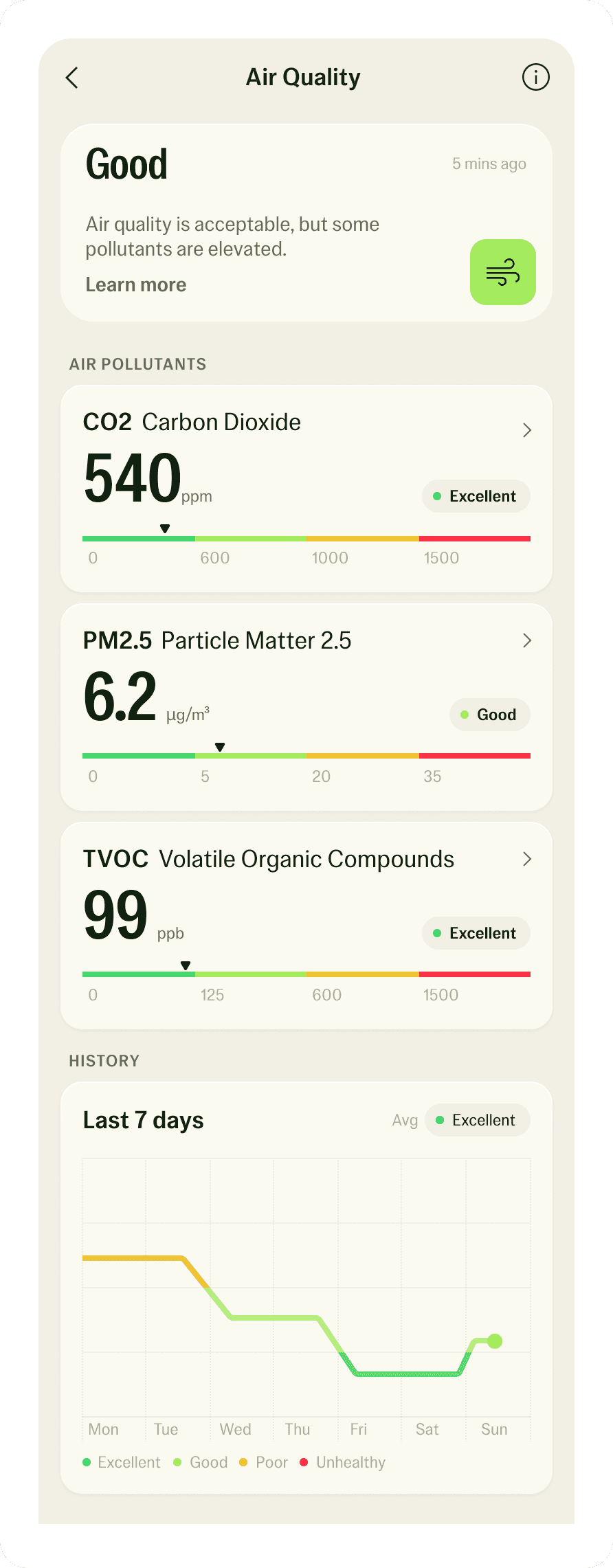
Understanding Your Air Score
Your Air Score summarizes the overall quality of the air inside your home.
After your system starts circulating air, it will take a few minutes before you see the current air quality reading. This is to allow time for the the monitor to sample air quality levels and provide an accurate reading.
Understanding Air Pollutants
Your Jetson Air monitor measures three different pollutants because each tells you something unique about the air inside your home.
PM2.5 — Fine Airborne Particles
What it is
PM2.5 consists of tiny airborne particles from sources like cooking, dust, smoke, and outdoor pollution. Measured in µg/m³ (micrograms per cubic meter).
Common sources
Why it matters
These tiny particles can reach deep into the lungs, irritating airways and worsening allergies and respiratory symptoms.
Typical range (µg/m³)
How to reduce it
Run your kitchen exhaust fan while cooking, replace your HVAC air filter regularly, and improve ventilation when particle levels increase.
CO₂ — Carbon Dioxide
What it is
Carbon dioxide (CO₂) is a gas people and pets breathe out. Levels rise in closed rooms and homes with poor ventilation. Measured in ppm (parts per million).
Common sources
Why it matters
High CO₂ can cause drowsiness, headaches, and reduced focus. It's often the clearest sign that fresh air isn't circulating well.
Typical range (ppm)
How to reduce it
Open a window or run ventilation regularly to bring in fresh air and reduce stale indoor air.
TVOC — Total Volatile Organic Compounds
What it is
TVOCs are gases released from products like cleaners, paints, furniture, and scented sprays. Measured in ppb (parts per billion).
Common sources
Why it matters
Elevated levels can cause headaches, eye irritation, and discomfort, especially in poorly ventilated spaces.
Typical range (ppb)
How to reduce it
Ventilate when using household products and choose low-VOC or unscented alternatives when possible.
Air Quality History
The History section shows how your home’s Air Score has changed over the past seven days.
Watching trends over time can help you identify what affects your home’s air quality, such as:
Rather than focusing on individual readings, look for recurring patterns that can help you improve your home’s indoor environment.
Tips for Better Indoor Air
A few simple habits can make a noticeable difference when air quality is measured as poor.