What Is an Indoor Air Quality Monitor?
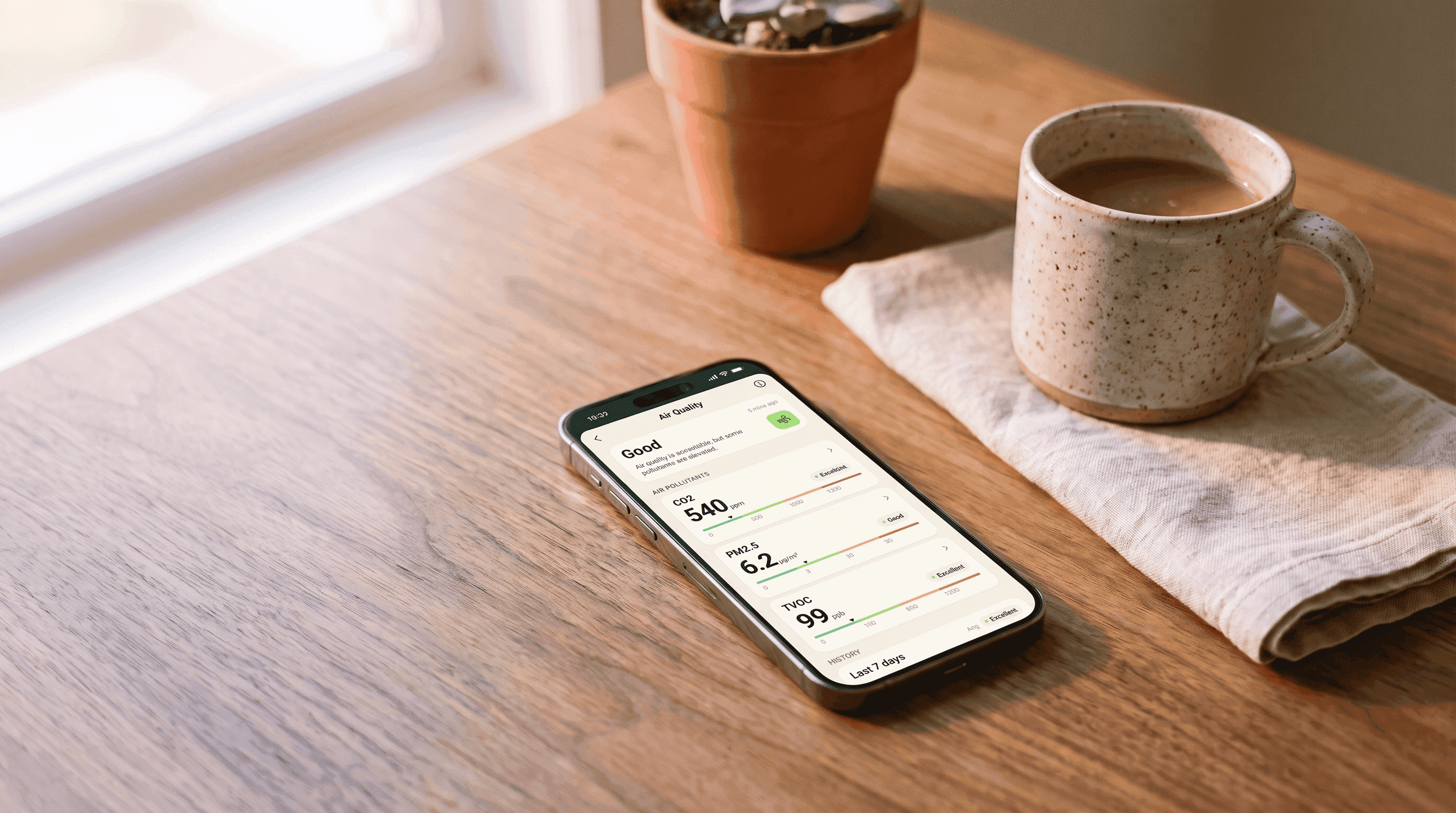
An indoor air quality monitor is a device that measures pollutants in the air inside your home, such as fine particles, carbon dioxide, or volatile organic compounds, and reports the results as a number, a category, or both. It's meant to answer a simple question: is the air in this room something you should be doing anything about right now?
How These Devices Typically Work
Most home air quality sensors on the market are standalone units. You plug them in, set them on a counter or shelf, and they sample the air around them more or less continuously, independent of anything else happening in the house. They typically track a handful of common pollutants and translate raw sensor data into a score or color-coded label on a companion app. That works fine as a general read on one spot in your home, but it has no awareness of your HVAC system, and no way to show your full-home air quality as a complete picture.
How Jetson Home's Air Quality Monitoring Works
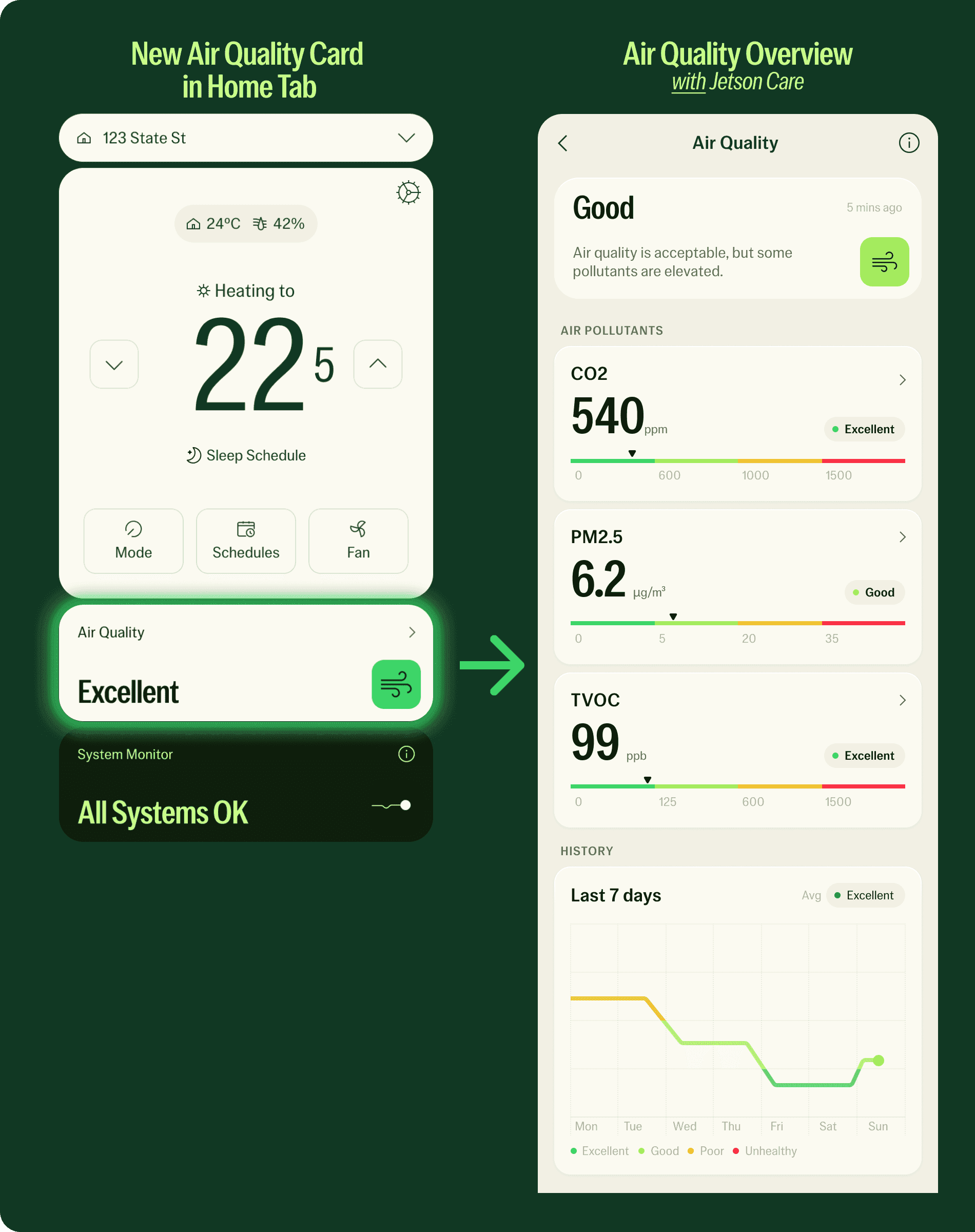
Here's how an indoor air quality monitor works when Jetson builds it in rather than sells it separately: sensors already inside your Jetson Air system measure pollutants while the system is actively heating, cooling, or circulating air, then report the results in the Jetson Home app. That one design choice shapes everything below: what you see for free, what you see with Jetson Care, and when the reading is live versus old.
Air Score (Included for All Customers)
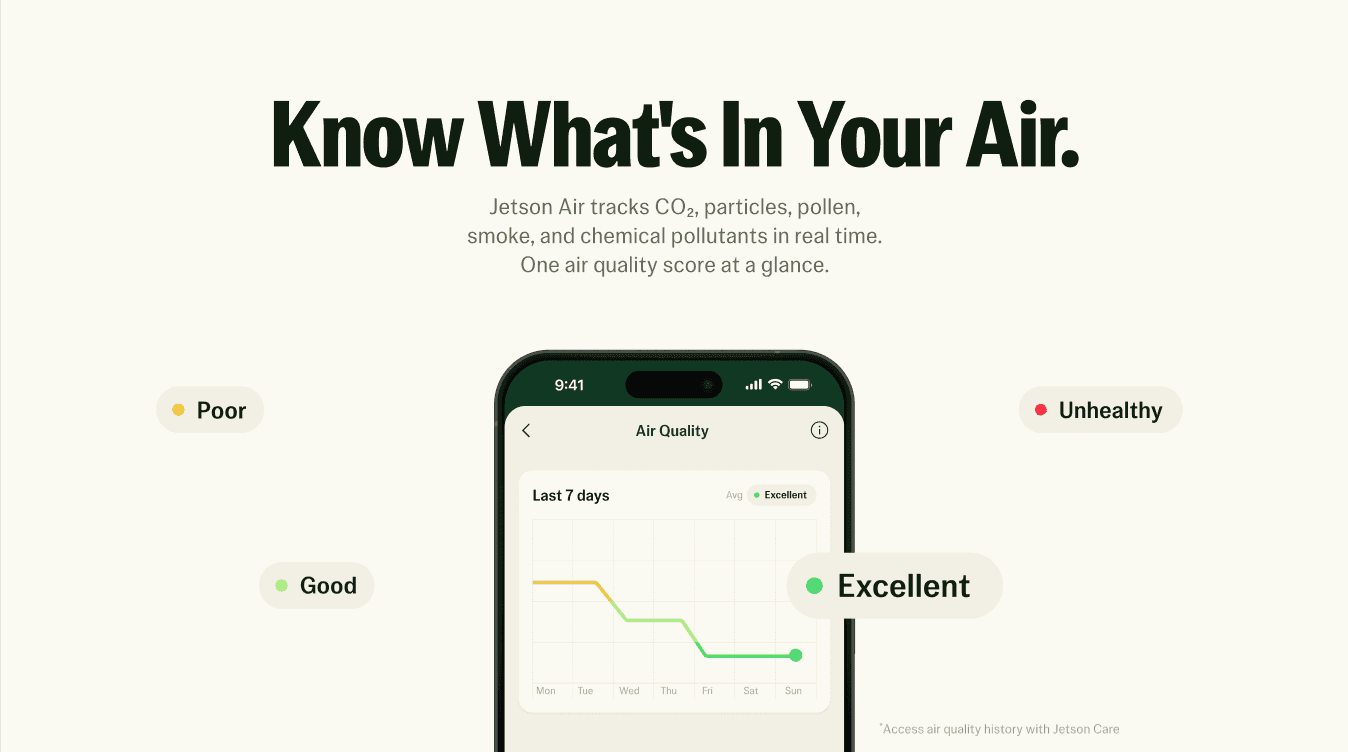
Every Jetson Home customer gets an Air Score, whether or not they're enrolled in Jetson Care. It's not a numeric 0-100 style score, it's a simplified category label, one of five, that tells you at a glance whether the air in your home is somewhere you'd want to spend the afternoon or somewhere worth cracking a window. You don't need to interpret raw pollutant numbers to use it.
Pollutant-Level Readings & 7-Day History (Jetson Care)
The Air Score is the free layer. If you want the detail underneath it, that's part of Jetson Care. Enrolled customers get individual pollutant-level readings, not just the composite label, along with a 7-day history, so you can see whether CO2 spikes every evening when the family's home, or whether a cleaning day shows up as a TVOC bump the next morning.
Why Readings Only Update While Your HVAC Runs (and What "Unavailable" Means)
Your air quality sensor only takes a new reading while the system is actively heating, cooling, or circulating air. When the system has been off for a while, the app doesn't fake a live number. It shows you the last reading it actually took, along with how long ago that was, labeled "Unavailable."
That's a deliberate choice. A standalone plug-in monitor samples the room constantly regardless of whether anything else in your house is running, which can give a false sense that the number on the app is always current. Jetson's version is more honest about it: if your system hasn't moved air recently, the reading is old, and the app says so instead of quietly presenting stale data as fresh. Once the system starts circulating air again, give it a few minutes before trusting the new number.
No New Hardware Needed: Delivered via an Over-the-Air Update to Your Jetson Air System
Air Quality Monitoring rolled out starting July 16, 2026, and it didn't require a single truck to show up at anyone's house. The sensors were already built into Jetson Air systems. What changed was an over-the-air software update to the Jetson Home app and system firmware, activating a capability that was sitting dormant in hardware customers already owned. No new equipment, no install visit to schedule. That's the advantage of building the sensor into the system in the first place: new capability can reach existing customers without anyone swapping out a box in their basement or attic.
"Jetson Air is the first heat pump system that manages not just home comfort, but also the health and quality of the air you are breathing. This update is a great example of the benefit of a modern connected system, where thousands of existing homes will receive a new feature they didn't have when the equipment was installed, something no other central heat pump system can do."
— Stephen Lake, co-founder and CEO of Jetson
What Pollutants Does It Track?
Jetson Air systems track three pollutants: PM2.5, CO2, and TVOC. Here's what each one is, where it comes from, and roughly what range you'd expect to see in a typical home.
| Pollutant | Excellent | Good | Poor | Unhealthy |
|---|---|---|---|---|
| PM2.5 (µg/m³) | 0–5 | 5–20 | 20–35 | 35+ |
| CO2 (ppm) | 0–600 | 600–1,000 | 1,000–1,500 | 1,500+ |
| TVOC (ppb) | 0–125 | 125–600 | 600–1,500 | 1,500+ |
PM2.5: Fine Airborne Particles
PM2.5 refers to fine particles small enough to reach deep into your lungs, where they irritate airways and can worsen allergy or respiratory symptoms over time. Common sources inside a home include cooking and frying, smoke, dust, candles and fireplaces, scented products, and outdoor pollution drifting in through doors and windows.
CO2: Carbon Dioxide
CO2 builds up indoors from people and pets simply breathing, especially in a closed-up house with the windows shut and not much fresh air moving through. High CO2 levels are associated with drowsiness, headaches, and reduced focus, which is why a stuffy room in the afternoon can leave you feeling foggy even if nothing else seems wrong.
TVOC: Total Volatile Organic Compounds
TVOC covers a broad category of chemical compounds that off-gas from things like cleaning products, air fresheners and scented sprays, paint, new furniture, and other building materials. At elevated levels, they can cause headaches and eye irritation, particularly in a room that isn't well ventilated.
How to Read Your Air Score
The Air Score condenses all of that into five plain-language categories, so you don't have to check three different pollutant readings every time you want to know how your air is doing.
| Air Score | What it means |
|---|---|
| Excellent | The air is exceptionally clean, ideal for comfort and everyday living. |
| Good | Pollutant levels are within a healthy range, nothing to act on. |
| Poor | Some levels are elevated, which can happen naturally after cooking, cleaning, or other everyday activity, and usually resolves on its own. |
| Unhealthy | Levels are high enough to affect comfort and well-being, worth taking a real step like ventilating or running your system. |
| Unavailable | Your system hasn't been heating, cooling, or circulating air recently, so the app shows the most recent reading with a timestamp instead of a live number. Give it a few minutes after the system kicks back on before expecting an updated reading. |
Indoor Air Quality Monitor vs. Standalone Sensors
Here's how the two approaches stack up in practice.
| Jetson Home (HVAC-integrated) | Typical standalone plug-in monitor | |
|---|---|---|
| Data source | Sensors built into your Jetson Air system | Separate device you place in a room |
| When it reads | Live while your system is heating, cooling, or circulating; last known value + timestamp when it's off | Samples continuously regardless of HVAC state |
| Access | Free Air Score for everyone; pollutant-level detail and 7-day history with Jetson Care | Usually a flat purchase price, sometimes an optional app subscription |
| Connection to your system | Tied directly to the equipment moving air through your home | No awareness of whether your HVAC is running at all |
A standalone monitor isn't a bad product. It just doesn't know anything about your HVAC system, which means it can show you a number without ever telling you whether that number reflects air that's actually circulating right now or air that's been sitting stagnant for hours. Jetson's version ties the reading to the system doing the actual work of moving air through your house, and says so plainly when that connection isn't currently active.
Tips for Better Indoor Air Quality
A few habits make a real difference, and if you're watching your Air Score, you'll usually see them show up as a category shift. A Poor score right after cooking or frying is almost always PM2.5, so running your kitchen exhaust or range hood while you cook keeps it from climbing in the first place. If CO2 creeps up in a closed-up room, opening a window or running ventilation regularly is the fix. Keep up with HVAC filter replacement too, since a clogged filter raises particle levels and makes your system work harder than it needs to. Running the fan on a low or continuous circulation setting between heating and cooling cycles keeps air moving and filtering. And when choosing cleaning products, air fresheners, or paint, low-VOC or unscented options keep the TVOC load down from the start.
FAQ
Key Takeaways
- Free for everyone: Every Jetson Home system includes an Air Score. Jetson Care adds per-pollutant readings (PM2.5, CO2, TVOC) and 7-day history.
- Live only while running: Readings update while your HVAC is moving air. When it's off, the app shows the last reading with a timestamp, not a fake live one.
- No new hardware: The sensors already ship inside every Jetson Air system, so the feature arrived as an over-the-air update, no install visit needed.
- The integration advantage: Because monitoring is built into the system rather than a separate gadget, an existing home gains the feature the day it's ready.
Curious what a Jetson Air system looks like for your home? You can see how Jetson's systems work, browse Jetson's product lineup, or get a quote to get started.