
The Basic Concept: Moving Heat Instead of Making It
Most heating systems work by burning something (gas, oil, propane) to create warmth. That process requires a lot of energy, and it always involves some waste. Even a high-efficiency gas furnace loses at least 5% of the energy in the fuel it burns.
Heat pumps take a fundamentally different approach. Instead of generating heat through combustion, they extract existing heat from the outdoor air and move it into your home. As long as the outdoor temperature is above absolute zero (–459.67°F), there's heat energy in the air, and modern cold-climate heat pumps are built to capture it efficiently even when conditions are well below freezing.
The underlying technology is the same basic principle that powers your refrigerator. Your fridge doesn't create cold air; it removes heat from the inside and releases it into your kitchen. A heat pump runs the same process in reverse, removing heat from the outdoor air and releasing it inside your home. When summer arrives, it switches direction and works like an air conditioner, pulling heat out of your home instead.
Why heat pumps use less energy
Because they're moving heat rather than creating it, heat pumps are dramatically more efficient than combustion-based systems. A gas furnace operates at 80 to 95% efficiency, meaning some portion of the energy you pay for is always lost in the process. A heat pump can achieve 200 to 500% efficiency, delivering two to five times the heat energy for every unit of electricity it consumes.
To put that in practical terms: if your old furnace uses 100 units of energy to give you 95 units of heat, a heat pump might use just 30 units of electricity to deliver the same level of comfort. The difference comes from the fact that the heat pump isn't generating heat from scratch. It's harvesting heat that already exists in the outdoor air, which requires far less energy.
The refrigeration cycle
At the core of every heat pump is a refrigeration cycle, a closed loop filled with refrigerant (a fluid that changes between liquid and gas states under different pressures and temperatures).
As the refrigerant flows through the system, it absorbs heat from the outdoor air, even in freezing conditions. Through a series of pressure changes and phase shifts, it then releases that collected heat indoors. Everything happens inside a sealed system of coils, a compressor, and expansion valves. There are no open flames, no combustion, and no exhaust gases. The same sealed loop works in both directions: heating your home in winter and cooling it in summer.
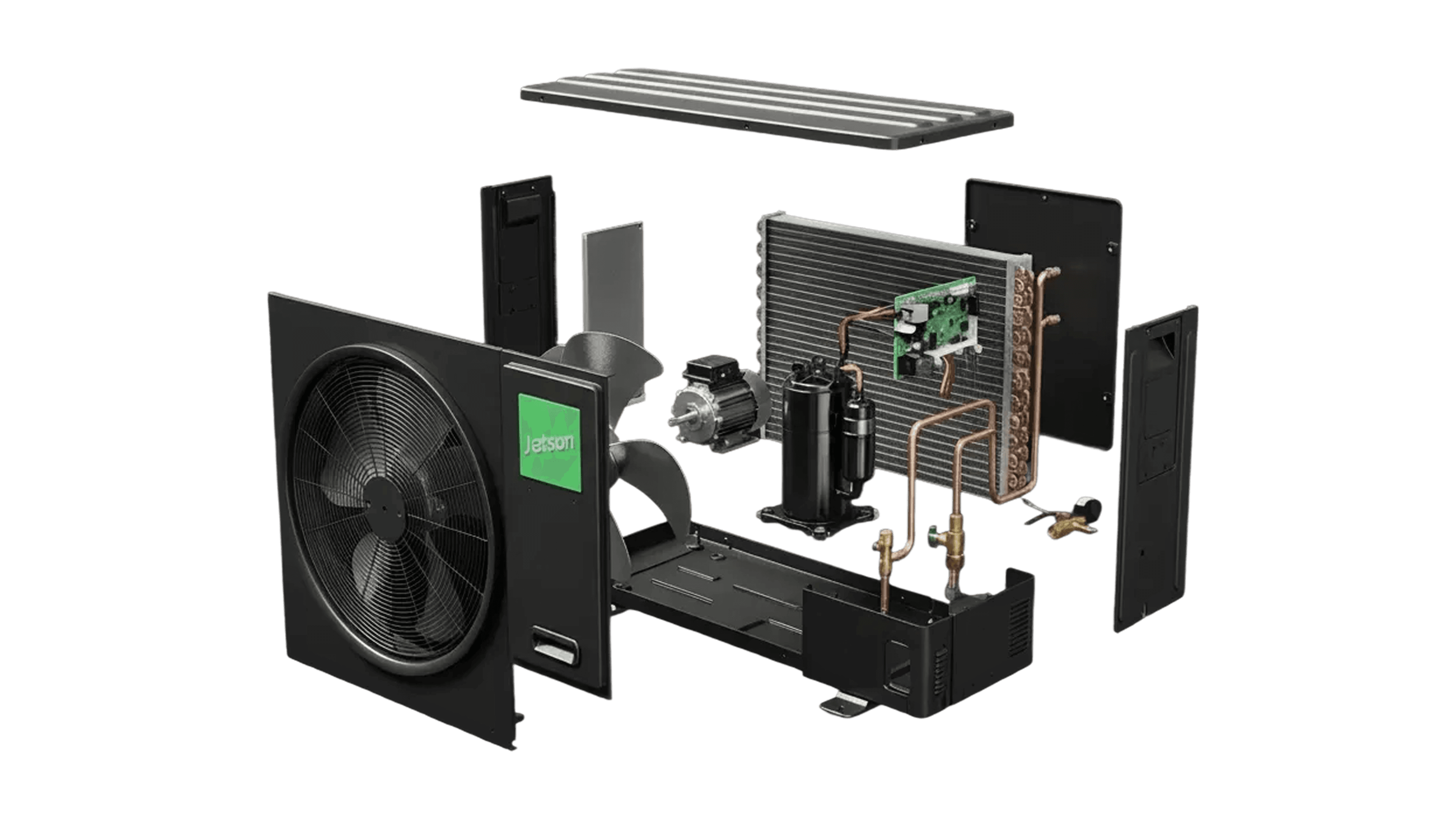
The Four-Step Heat Pump Cycle
Step 1: Extracting heat from outdoor air
Everything starts at the outdoor unit. The refrigerant inside the heat pump's coil absorbs heat from the surrounding air as it passes through. Because the refrigerant has a very low boiling point, it can pick up heat energy even when outdoor temperatures are well below freezing. Jetson's cold-climate systems are designed to extract heat from outdoor air as cold as –22°F (–30°C).
Step 2: Compressing to increase temperature
The refrigerant, now a low-temperature gas carrying the heat it absorbed outside, enters the compressor. Here it's compressed into a smaller volume, which raises both its pressure and temperature significantly. The principle is the same as a bicycle pump: air heats up when you compress it. The result is a hot, high-pressure gas that's ready to deliver warmth indoors.
Step 3: Releasing heat inside your home
The hot refrigerant flows to the indoor coil, where a fan blows your home's air across it. The heat transfers from the refrigerant into the air, which is then distributed through your ductwork. As the refrigerant releases its heat, it cools down and returns to a liquid state, ready to head back outside and start the cycle again.
Step 4: The cycle repeats (and reverses for cooling)
After releasing its heat indoors, the refrigerant returns to the outdoor unit to pick up more heat. This loop runs continuously, adjusting its output to match your home's needs and the outdoor conditions. In summer, the entire process runs in reverse: the system pulls heat from your indoor air and releases it outside, cooling your home the same way an air conditioner does.
Heating and Cooling From One System
Why one system saves money
Beyond the energy efficiency advantage, a heat pump also eliminates the cost and complexity of maintaining two separate systems. You don't need a furnace for winter and an air conditioner for summer. You have one system to install, one to maintain, and one to eventually replace.
That simplicity has real financial value over time. Fewer components means fewer things that can break, fewer service calls, and lower maintenance costs. When you combine the reduced maintenance burden with the lower operating costs from higher efficiency, most homeowners see a strong return on their investment within a few years, especially when available rebates are factored in.
Want to see what this looks like for your own home? You can see your costs, savings, and local rebates from your address.